Snorri Sturluson’s Edda (c. 1220) and the poems of the Poetic Edda, side by side with translations: the normalised Old Norse, the same text in modern Icelandic spelling, and a public-domain English translation (Brodeur 1916 for Snorri, Bellows 1923 for the poems), aligned paragraph by paragraph and stanza by stanza. More languages will follow as columns.
About the texts, the alignment and the project
What the bars show
edition textplaced automaticallyplacement checkedtext not reviewedtext revieweddisputedempty
Old Norse. Guðni Jónsson’s normalised texts of Edda Snorra Sturlusonar (Íslendingasagnaútgáfan, 1954) and of the Eddukvæði (1949), as published on heimskringla.no. Chapter and stanza numbers follow those editions; the chapter headings are his, with English renderings made for this edition (AI drafts, marked as such). The medieval texts are in the public domain; whether Guðni Jónsson’s normalised editions carry rights of their own has not yet been settled, and permission is being sought.
Modern Icelandic. For Gylfaginning and five poems (Hávamál, Völuspá, Þrymskviða, Völundarkviða, Helgakviða Hundingsbana II), Netútgáfan’s editions in modern spelling (Snerpa, 1996–1997). Everywhere else the column is an automatic modernisation of the Old Norse, learned word by word from the Gylfaginning pair and marked as such; a held-out test on Gylfaginning gives about 94% of words right (against 72% if the Old Norse were left unchanged).
English. Snorri: Arthur Gilchrist Brodeur, The Prose Edda (1916), public domain, from the sacred-texts.com transcription; he left out Háttatal, for which the column is an AI draft made for this edition, unreviewed and marked as such. Poems: Henry Adams Bellows, The Poetic Edda (1923), public domain, from the Wikisource transcription, with his notes and introductions; for the nine Eddic poems he did not translate (Gróttasöngr, the five poems preserved in sagas, Eddubrot, Sólarljóð, Forspjallsljóð) and the few stanzas he left out, the English is Brodeur’s where Snorri quotes the stanza, and otherwise an AI draft made for this edition, unreviewed and marked as such. A vertical gap inside a verse line marks a half-line division.
What the labels mean. Every cell answers two questions. Where does the text come from? The Old Norse is the edition (Guðni Jónsson); the English and the Gylfaginning Icelandic are published human texts (Brodeur, Bellows, Netútgáfan); the other Icelandic is an automatic spelling modernisation; Háttatal’s English and the gaps in the poems are AI drafts; later cells may be written by contributors. What has a person checked? For a published text only its placement in the row can be wrong, so its label says “placed automatically” until someone confirms the row and it becomes “placement checked”. For automatic spelling, AI drafts and contributions the words themselves are at stake: “not reviewed” until a reviewer accepts them, then “reviewed”. “Disputed” means reviewers disagree and both readings are shown. The progress bars count the same states.
Alignment. Each row is one paragraph or stanza of the Old Norse. The translations were matched to it automatically — for Snorri by sentences (wording for the Icelandic; names, speakers, verse structure and length for the English), for the poems by stanza (names, a word list learned from Snorri’s rows, numbering and length). Rows marked ? are weak matches. Stanzas Snorri quotes are linked both ways.
Illustrations. Chapters that call for a picture carry an illustration slot. Public-domain depictions and openly licensed photographs (manuscripts, monuments, places) come from Wikimedia Commons with their credit and licence; the rest keep a dashed “illustration wanted” slot.
Open project. Everything here is built by scripts from openly available sources, and the data is open, so every row can be corrected: the alignment, the automatic Icelandic, the translations, and later new translations and new languages. Row numbers (e.g. 12.3, or st. 19 in a poem) are the stable references for reporting a fix; the small “report” link at every row sends a message to the editors with the row attached.
Rights and removal. The texts here are in the public domain, openly licensed, or freely published online and used with their source named on every column. If you hold rights in a text shown here and object to its use, write to rights@openedda.is and it will be taken down.
Privacy. Open Edda counts visits with Umami, a privacy-friendly analytics service. It sets no cookies and stores nothing that identifies you: we see totals such as how many people read which chapter, for roughly how long, from which country, and which features are used. Your IP address is used only to work out the country and is not stored. Search words are recorded only when a search finds nothing, so we can fill the gap. Your browser's "Do Not Track" setting is respected, and you can switch counting off here: If you sign in to suggest corrections, we store your Google account id with your suggestions and, if you tick reading paths, those ticks; nothing else. To have your data deleted, write to hello@openedda.is.
Start here
What the Eddas are, how to read this page, and five reading paths
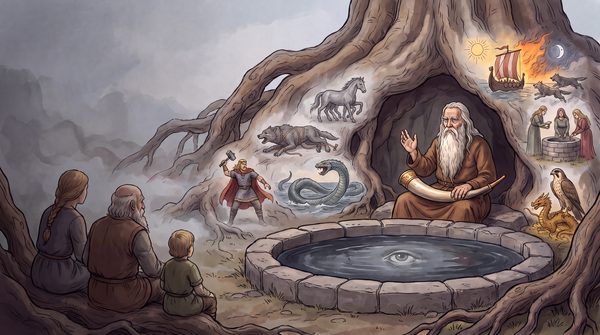
Óðinn has two ravens that fly over the world and bring him news, and he asks Mímir, the wise one at the well, for counsel. Here they help you.
Huginn · thought
Ask him at the top of any page: a name, a chapter, a poem, a setting. He also carries your word to us: the raven at the bottom of the page takes an idea, a mistake or a problem.
Muninn · memory
He remembers for you: how far you have come on the reading paths, and the notes you write in Review or Suggest mode. Sign in, and he keeps them with your account on every device; only you see your notes.
He tells the stories: who is who, what happens in what order from the void to Ragnarök, tours, and what people often get wrong. Every fact points to its passage.
Every god, giant, hero, place and thing in the Eddas has a page: its card, its forms and every passage that names it. Point at a marked name in the text to see who it is.
Sköll runs after the sun and Hati after the moon (Gylfaginning 12). A translation runs after its original the same way — and never quite catches it.picture: John Charles Dollman · Public domain · Commons
What the two Eddas are
There are two Eddas. The Prose Edda, also called Snorri's Edda, Snorra Edda or the Younger Edda, was written by Snorri Sturluson in Iceland around 1220 as a handbook for poets: it explains the kennings of skaldic verse and, to do so, retells the myths of the gods from the creation of the world to Ragnarök. It has four parts: the Prologue (Formáli), Gylfaginning, Skáldskaparmál and Háttatal. The Poetic Edda, also called the Elder Edda, Sæmundar Edda or, in Icelandic, Eddukvæði, is a collection of older, anonymous poems, kept mainly in one manuscript of about 1270, the Codex Regius (Konungsbók): mythological poems such as Völuspá and Hávamál, and heroic poems about Sigurðr and the Niflungs. Snorri quotes many of them.
Reading paths
Five ways through the texts, each a numbered list of links with a rough time. Tick a step when you have read it; Muninn, the raven of memory, keeps the ticks in this browser. Sign in (top of the page) and he keeps them with your account, on every device you sign in on.
Each row shows the Old Norse text with its Icelandic and English counterparts side by side. The Columns chips show or hide a language; View switches the name marks and the background drawings.
Reading shows the text with only what a reader needs: AI drafts are marked as drafts, and a thin dotted edge marks the automatic modern Icelandic spelling that no one has checked yet. Details shows for every cell where its text comes from and whether a person has checked it (a published translation is "placed automatically" until a reviewer confirms the row), and a bar at the top of each part counts the rows by state.
Hover over or tap a name to see who or what it is; the Names section lists every name with every mention, and the real places on a map.
Know Icelandic or English well? You can help check the texts: Help improve.