
Rígr walks among men
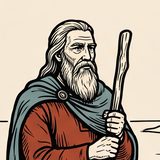
A god calling himself Rígr spent three nights in each of three houses. Nine months later each wife bore a son.
Mímir: AI draft · not reviewed
- Old stories say, according to the prose before the poem, that one of the Æsir, called Heimdallr, went along a seashore, came to a farmstead and called himself Rígr. The poem itself only says that in early days an old, wise, strong god walked the green roads: Rígr. Rígsþula 1
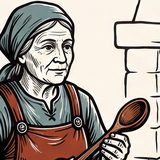
- He came to a house with a fire burning on the floor. An old couple sat by the hearth, Ái and Edda. Rígr knew how to give them counsel. Edda brought a heavy, thick loaf full of husks, broth in a bowl, and boiled calf, the best of the dishes. He lay down in the middle of their bed, one of them on each side, and stayed three nights. Then he went on his way, and nine months passed. Rígsþula 2, Rígsþula 3, Rígsþula 4, Rígsþula 5, Rígsþula 6
- Edda bore a son. They sprinkled him with water and called him Þræll. He was dark, with wrinkled skin on his hands, knotted knuckles, thick fingers, an ugly face, a bent back and long heels. He bound bast, carried loads and brought home brushwood all day. Rígsþula 7, Rígsþula 8, Rígsþula 9
- A girl called Þír came to the farm, with crooked legs, mud on her soles, sunburnt arms and a hooked nose. She and Þræll had many sons and daughters, who dunged the fields, kept pigs and goats and dug turf. 'And thence has risen the race of thralls.' Rígsþula 10, Rígsþula 11, Rígsþula 12, Rígsþula 13
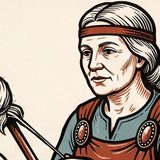
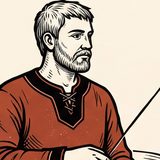
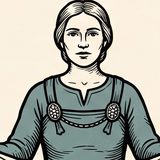
- Rígr walked on to a hall where Afi and Amma sat at work. The man was shaping wood for a loom, his beard trimmed and his shirt close-fitting; the woman was spinning, with a band on her head and brooches on her shoulders. Again Rígr gave counsel, ate boiled calf, lay between them for three nights, and nine months passed. Rígsþula 14, Rígsþula 15, Rígsþula 16, Rígsþula 17, Rígsþula 19, Rígsþula 20
- Amma bore a son, red and ruddy with bright eyes, and they called him Karl. He tamed oxen, made ploughs, built houses and barns, made carts and drove the plough. He married Snör, who came in a goatskin dress with keys at her belt. From their many sons and daughters came the free farmers. Rígsþula 21, Rígsþula 22, Rígsþula 23, Rígsþula 24, Rígsþula 25
- Next Rígr came to a hall with its doors facing south. Inside sat Faðir and Móðir, gazing into each other's eyes. The husband was twisting a bowstring and fitting shafts to arrows; the wife, in a fine headdress and blue-tinted shirt, was smoothing linen, her neck whiter than new snow. Móðir laid an embroidered cloth with thin white wheat loaves, silver dishes, pork, roast birds and wine. Again he stayed three nights, and nine months passed. Rígsþula 26, Rígsþula 27, Rígsþula 28, Rígsþula 29, Rígsþula 31, Rígsþula 32, Rígsþula 33
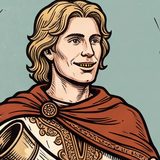
- Móðir bore a son, wrapped him in silk and called him Jarl. His hair was fair, his cheeks bright, his eyes as fierce as a young snake's. He grew up handling shields, bows, spears, horses, hounds and swords. Then Rígr came walking out of the thicket, taught him runes, gave him his own name, and claimed him as his son. He told him to take possession of his ancestral lands. Rígsþula 34, Rígsþula 35, Rígsþula 36
- Jarl rode through dark forest and over frosty mountains, fought, reddened the field and won lands. He ruled eighteen farms and gave out treasure, horses and rings. His messengers fetched Erna, the slender-fingered, wise daughter of Hersir, and they lived happily and had many sons. The youngest, Konr, knew runes that could save men, blunt blades and calm the sea, and he understood the speech of birds. He matched runes with Rígr Jarl and knew more, and so won the right to be called Rígr himself. Rígsþula 37, Rígsþula 38, Rígsþula 39, Rígsþula 40, Rígsþula 41, Rígsþula 43, Rígsþula 44, Rígsþula 45
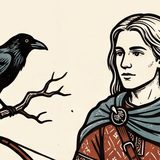
- Young Konr rode through the woods, shooting and snaring birds. A crow on a branch asked him why he was luring birds when he could be riding horses and fighting. Danr and Danpr, it said, had finer halls and better lands than his, and knew how to sail a ship and how to wound. Soon after this the poem breaks off. Rígsþula 46, Rígsþula 47, Rígsþula 48
Where the sources differ
Only the prose before the poem says that Rígr was Heimdallr; the poem calls him an old, wise and strong god (áss). The poem does not say outright that Rígr fathered Þræll and Karl: it says he lay three nights between each couple and that a son was born nine months later, and only Jarl does Rígr claim as his son (rth-s36). Snorri does not tell this story. Völuspá opens by asking a hearing from Heimdallr's sons, 'both high and low' (vsp-s1), which may reflect the same idea; the poem does not explain the phrase.
Read it yourself
- Rígsþula 1 — The prose that names the wandering god as Heimdallr.
- Rígsþula 8 — Þræll described, from knuckles to heels.
- Rígsþula 36 — Rígr comes out of the thicket and claims Jarl as his son.
- Rígsþula 48 — The crow's taunt, where the poem breaks off.
Who takes part

Why here in the order: Age 3: the poem opens 'Ár', in early days, and tells how the ranks of people began, so it follows the making of the first humans and comes before the gods' wars. No source dates it more closely; this is a reading aid.