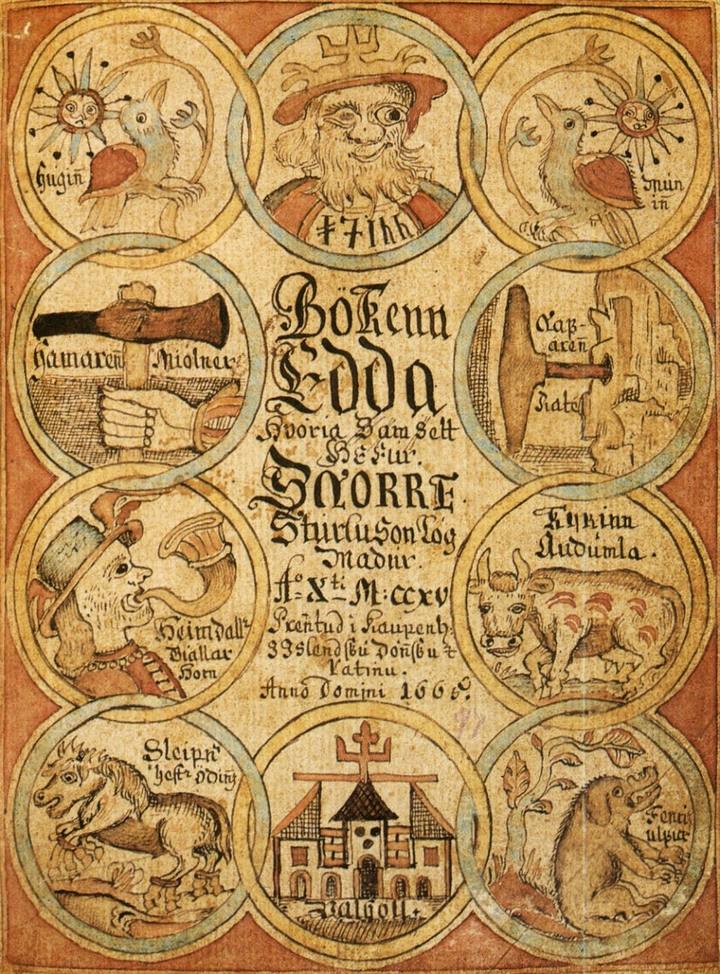
Open Edda is work in progress: what has changed, newest first.
November 2026
Texts
📖Five poems in published modern Icelandic
Hávamál, Völuspá, Þrymskviða, Völundarkviða and Helgakviða Hundingsbana II now show Netútgáfan’s modern-spelling text in the Icelandic column instead of our automatic spelling, credited and linked on each poem. In Völundarkviða, where Netútgáfan divides a few stanzas differently, those rows keep the automatic text for now.
New
📜Where every text comes from
A new page, Sources and licences, lists each text the site shows: its edition, where it was taken from and its rights status, column by column. It also says what is still open, what Open Edda adds itself and under which licence, and how a rights holder can reach us.
New
🔎Easier to find, in English and in Icelandic
Every page now has its own address in each interface language: the Icelandic pages live under openedda.is/is/, and the language menu takes you to the same page in the other language. Each chapter, poem and name also comes as plain text, linked at the end of the page, for copying and for assistants such as ChatGPT and Claude, which can now quote a passage with its source and its label.
New
🕯️A candle for reading at night
A small game for night owls. Turn on A candle at night in the View menu, and after sunset where you are the page goes dark and a little flame follows your mouse, lighting the text around it. It flickers, and leans as you move it. Off by default, and only with a mouse; move the pointer out of the window, or press Escape, to put it out.
New
📜Why Open Edda, and what's new
Open Edda now says plainly that it is work in progress: look for the badge next to its name. There is an About page, a personal note on why it exists and where it is going, and this page, where every change worth noticing is written down, newest first.
New
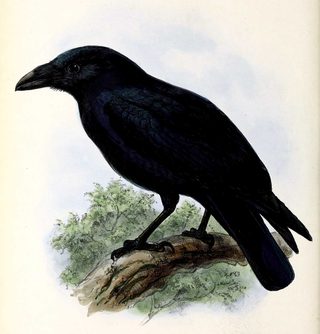
✉️Huginn brings a letter
The raven in the corner of every page now holds a letter in his beak, which makes it clearer what he is for: click him to send us an idea, a mistake you spotted or anything else on your mind. As before, he comes in three lights, day, dusk and night, following the sunrise and sunset where you are.
New
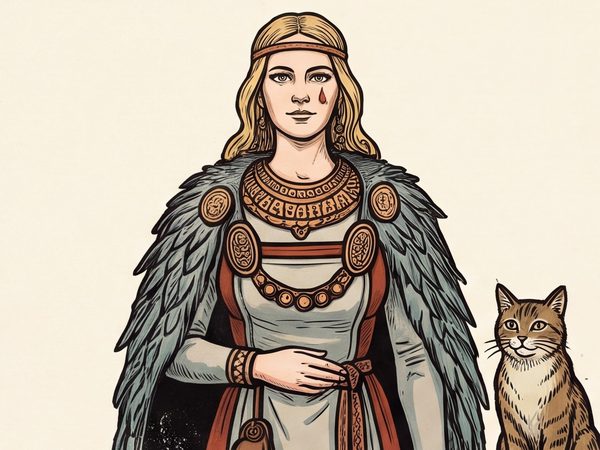
🎨A portrait for every Mímir card
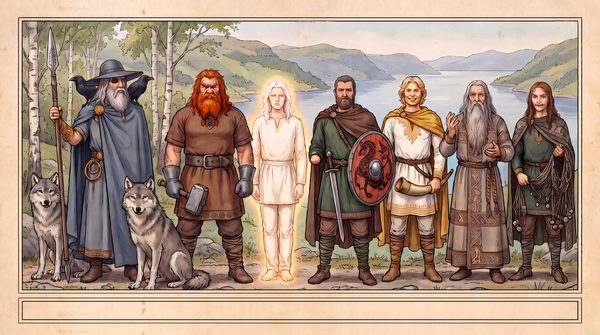
All 333 cards in Mímir's Who is who now have a portrait of their own, from Óðinn with his one eye to Freyja weeping tears of red gold. Each comes in three lights, day, dusk and night, and the page shows the one that roughly matches the sky outside your window. Gold, we are pleased to report, stays gold after dark.
New
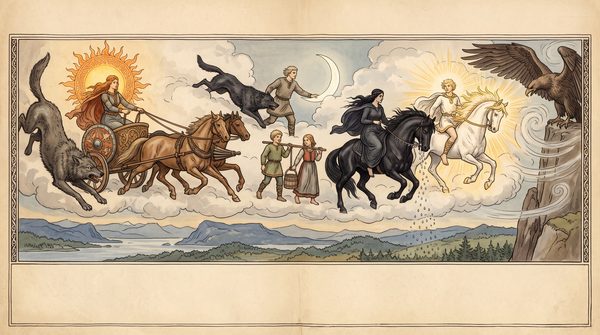
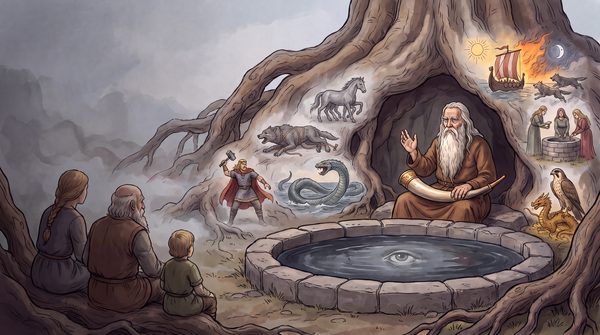
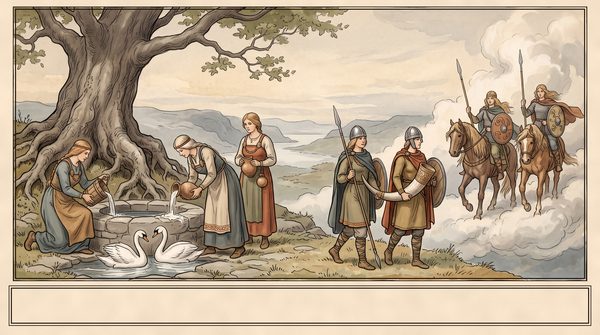
🖼️Fourteen new picture plates in Mímir
Mímir has fourteen new illustrated plates (P5 to P18), joining the first four, and every labelled figure on them opens its card. Plates now also appear on the story pages and in the ages of the timeline: the end of the world sits with Ragnarök, the first dwarves with the creation. We also fixed labels, such as Freyja's cats and her boar Hildisvíni.
Improved
🏷️Titles in both tongues
Every chapter and poem now carries its heading in English and Old Norse, English first: ‘Gylfaginning 1: Of King Gylfi and Gefjun (Frá Gylfa konungi ok Gefjuni)’, ‘Hávamál (The Sayings of the High One)’. Each page also opens with its own text rather than the welcome from the front page, which should help search engines, and you, land on the right page.
New
🐦⬛Huginn, the feedback raven
Huginn now perches in the corner of every page. In the myth he flies out each day and brings Óðinn the news; here he brings it to us. Click him to send an idea, a mistake in the text or a problem with the site. Select a passage first and it travels with your message. An email address is optional. His picture follows the sun: day, dusk or night, by your local sunrise and sunset.
Texts
💬Mímir speaks Icelandic
Switch the interface to Íslenska and Mímir now speaks Icelandic too: cards, stories, tours, misconceptions and outside sources, nearly 4,800 pieces of text in all, plus the 587 short summaries in the Names index. These are AI translations, labelled as drafts until an Icelandic reader has checked them. Corrections are very welcome.
Texts
✍️English · modern for almost everything
Our plain modern English, made with AI from the public-domain translations of Brodeur (1916), Bellows (1923) and Thorpe (1866) and labelled as a draft, now runs beside almost the whole edition: the Prologue, all of Gylfaginning, Skáldskaparmál and the poems, 2,890 rows in all. Háttatal will have to wait. Turn it on under Columns.
Improved
🧩Faces on the Mímir tiles
The small pictures in Mímir's Who is who are now cut with care. Each of 98 pictures has a hand-set focus: the face for people, the head or shape for animals, the subject for places. Figures taken from the large plates run from the head down to the things that tell them apart, so you can spot who is who at a glance.
Launch
💧Meet Mímir, a guide to the myths
The Eddas are wonderful and not always easy. Mímir is a new guide for the curious: 331 cards on gods, giants, heroes and things, the whole tale from the void to Ragnarök in 40 stories across eight ages plus a heroes' line, guided tours, common misconceptions and what comes from outside the Eddas. Everything was checked against the Old Norse rows it cites, and links to them.
New
🔍Pictures to explore in Mímir
Mímir's first four picture plates are in: large illustrated scenes where every labelled figure can be clicked to open its card. The opening picture on the front of Mímir works the same way, with scenes you can click into, and the cards and tiles borrow their pictures from the plates.
New
🗣️How to say it
Not sure how to pronounce Þjazi or Yggdrasill? Every Mímir card and Names entry now has a short pronunciation line under its headword, and a pronunciation page explains the sounds of Old Norse. The norns and the valkyries also got groups of their own, with Urðr joining as a card in her own right.
Improved
🚪One way in
The top bar is simpler: Read · Mímir · Names · Help improve, and the Open Edda name takes you home. The front page offers three doors, depending on what you came for; each reading path asks ‘Tour first?’ when Mímir has a matching tour; and chapter and poem pages link to their stories in Mímir.
Improved
🖌️A fresh coat of paint
The contents now show each chapter as a card, and the text sits at a comfortable reading width, with full width one click away under View. Name cards are bigger and show a large picture with a description when you hover over a name, and both the contents and the Names index can be browsed as cards or as a plain list.
Improved
🔗A page for every chapter, poem and name
Open Edda used to be one long page. Now every chapter of Snorri's Edda, every poem and every name has its own address, 803 pages in all, which you can bookmark, share and cite. Old links still land in the right place, and the text of each page is there even in the simplest browser.
Improved
📊Counting visits, kindly
We now count visits so we can see which parts get read, with a privacy-friendly counter that records which pages are read, not who reads them. If your browser asks not to be tracked, we listen, and a switch in the privacy note on Help improve turns the counting off altogether.
Texts
📚Anderson and Thorpe join the English
A language can now have several versions side by side. English gained two classic public-domain translations: Rasmus B. Anderson's Younger Edda (1880) for Gylfaginning, 335 rows, and Benjamin Thorpe's Edda of Sæmund (1866) for 33 poems, 1,464 rows. Add them from the small ‘+’ menu beside a language under Columns.
New
✨English · modern, a first taste
We tried something new: a plain modern English reading of Gylfaginning chapters 1 to 10, made with AI from Brodeur's 1916 translation and clearly labelled as an unreviewed draft. Brodeur's English is lovely but a century old; this sits beside it, switched off by default, for readers who would like something plainer.
Texts
📇Names get a summary
Entries in the Names index now open with a short summary: who or what this is, where they appear in the Eddas and how they relate to others, noting where the sources disagree. 587 of the 598 names have one. They are AI drafts and say so. The entry's picture is now shown large, with its credit.
Improved
🗺️The map of the worlds, in two languages
Every label on the map of the worlds now gives both the Old Norse and the English name, places and beings have markers of their own, and names appear as you hover. ‘Show all names’ puts every label up at once; ‘Painting only’ clears them away so you can simply look. Grigory Sapunov also redrew the painting, adding four new entries.
New
✏️Suggest a correction
Spotted a wrong word, or a row in the wrong place? Sign in, agree once that your work may be shared under CC BY 4.0, and suggest a correction right in the text. Reviewers see it and can accept it with one click, and you can be credited by name. The new Help improve page shows what is still unchecked, part by part.
Improved
👓Reading, Details or Review
A new switch in the header chooses how much the page tells you. Reading keeps it quiet; Details shows where every text comes from and how it was placed. Unchecked text stays marked in both. The header now stays in view as you scroll, footnotes link back to their place in the text, and name cards sit in a steady margin so the columns line up.
New
🪶Muninn remembers you
Muninn, Óðinn's raven of memory, used to keep your ticks on the reading paths in one browser only. Sign in and he now keeps them with your account, so you can pick up where you left off on another device, whether that is a laptop at home or a phone on the bus.
Launch
🎉Open Edda is live at openedda.is
Open Edda now has its own address, openedda.is, free for anyone to read: Snorri's Edda and the Poetic Edda in Old Norse, modern Icelandic and English, row by row. Reviewers can sign in and mark each row, picture and name as right or wrong, and the first checked rows followed within days.
New
📖The Names index
Who is Hárbarðr? The Names index lists 598 gods, giants, dwarves, heroes, places and things, each with pictures, other spellings, links and every mention in context. Search by any spelling (thiazi, Thjazi and Þjassi all find the same giant) in Huginn's search box, filter by kind, and see the real places on a map.
New
🔦Names marked in the text
Over 17,000 mentions of names are now marked in the Old Norse, Icelandic and English columns. Hover over one, or tap it, for a card with a picture, a short description and links; where a figure first appears in each book, a card waits in the margin. Prefer a clean page? Turn the marks off.
New
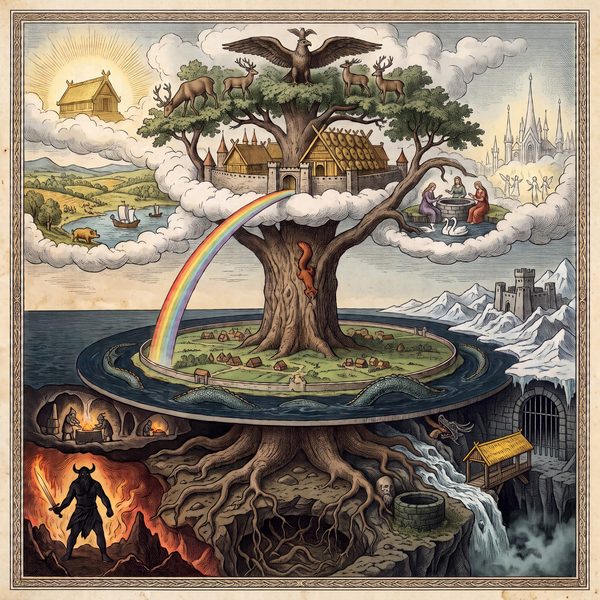
🌳A map of the worlds
The map of the worlds is a painting of the Norse cosmos, from Ásgarðr to Hel, with 37 realms, halls and beings placed on it. Click one to read what the sources say and which rows put it there. Three historic diagrams, Wheaton's and Bagge's among them, show how others have drawn it.
New
🧭Start here, with reading paths
New to the Eddas? The front page now begins with a short welcome, a note on how to read the page and five reading paths, 32 steps in all, through the best-known stories. Tick off each step as you go; Muninn, Óðinn's raven of memory, remembers where you got to.
New
💬Íslenska in the interface
Menus, buttons and labels can now be switched between English and Icelandic, and on your first visit the page picks whichever your browser prefers. The Icelandic wording is our own draft and still waits for a native speaker's eye, so if something sounds odd, do tell us.
Texts
📝Introductions to every part and poem
Each part of the edition now opens with a short introduction and a note on how to read it, and every poem has a headnote under its title. On the front page, one card per part shows how much of each column has been checked. The introductions are AI drafts in English and Icelandic, labelled as such.
Improved
🏷️Honest labels on every row
We now say plainly where each text comes from and how sure we are of it: ‘Brodeur 1916 · placed automatically’, ‘automatic spelling · not reviewed’, ‘AI draft · not reviewed’. Progress bars show, part by part and column by column, how much has been checked, and every row has a link for reporting a problem.
Texts
🌀Thorpe for two strange poems
Sólarljóð, the Christian ‘Song of the Sun’, and Hrafnagaldr Óðins had only AI-drafted English until now. They now carry Benjamin Thorpe's 1866 translation, by a real person with real footnotes, his notes included: 82 and 26 stanzas, matched one to one with the Old Norse.
Improved
↩️Links that work, and the Back button too
The header was rebuilt as a site bar and a reading bar, with the parts as tabs, a chapter menu and column switches that fit on a phone. Every click in the menus now changes the address, so the Back button takes you where you expect and any spot in the text can be shared.
October 2026
Texts
🎶The whole Poetic Edda
Snorri has company: starting with Völuspá, all 45 poems of the Poetic Edda, 1,966 rows, in Guðni Jónsson's Old Norse, with modern Icelandic spelling and English. Bellows' 1923 translation covers 36 poems; elsewhere the English is an AI draft, marked on every row. Where Snorri quotes a stanza, 91 links lead between the two books.
New
🪨Manuscripts, stones and places
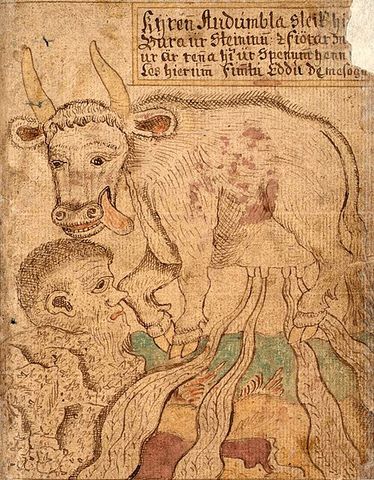
Alongside the illustrations, 33 photographs of manuscripts, carved stones and the places of the stories now sit beside the chapters they belong to, each with its licence and author. Any picture opens full screen with a click. We have kept them sparing, so the text stays the star.
New
✒️A name: Open Edda
The project has a name: Open Edda, Opin Edda in Icelandic. Open because the texts, the work on them and the mistakes are all out in the open, and anyone may read, reuse and correct them. The chapter and poem titles were translated too, 196 of them, so each heading reads in the languages you show.
New
🎨Illustrations and a background of runes
Forty public-domain illustrations from Wikimedia Commons now sit by the scenes they show, each with its artist and source; two turned out to show the wrong scene and were taken down again. Behind the text runs a faint pattern of small line drawings and Younger Futhark runes, different for each part.
Launch
🌱Where it all began
Open Edda began with Snorri's Edda in three columns, row by row: Guðni Jónsson's Old Norse, modern Icelandic (Netútgáfan's for Gylfaginning, our automatic spelling elsewhere) and Arthur Gilchrist Brodeur's 1916 English. The Prologue, Gylfaginning, Skáldskaparmál and Háttatal were lined up in 1,514 rows. Háttatal had no English, so we drafted one with AI and labelled every line.
· j / k row · h / l item · v right · x wrong · a alignment ok · n note · Esc leave· test mode: the marks stay in this browser