
The binding of Fenrir
The gods would not kill the wolf in their sanctuary, so they tied him with a ribbon made of things that do not exist.
Mímir: AI draft · not reviewed
- Loki had three children with the giantess Angrboða in Jötunheimar: the wolf Fenrir, the serpent Jörmungandr, and Hel. Gylfaginning 34
- Prophecies told the gods that great harm would come from these three, bad through their mother and worse through their father. Óðinn had them brought to him. He threw the serpent into the sea around the world, where it grew until it circled all lands and bit its own tail. He threw Hel into Niflheimr and gave her rule over those who die of sickness or old age. Gylfaginning 34
- The Æsir raised the wolf at home, and only Týr dared to feed him. He grew every day, and the prophecies said he would harm them. So they made a strong fetter, Læðingr, and asked him to test his strength on it. He broke it at the first kick. Gylfaginning 34
- They made a second fetter, Drómi, twice as strong. The wolf knew it was strong, but he had grown too, and he wanted fame, so he let them put it on. He shook himself and broke it, and the pieces flew far. Gylfaginning 34
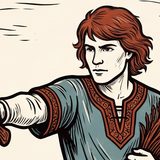
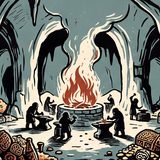
- Óðinn then sent Skírnir, Freyr's messenger, to dwarfs in Svartálfaheimr. They made Gleipnir from six things: the noise of a cat's footsteps, a woman's beard, the roots of a mountain, a bear's sinews, a fish's breath and a bird's spit. Snorri's narrator points out that women have no beards, a cat's step makes no sound and mountains have no roots. Gylfaginning 34
- Gleipnir was soft and smooth like a silk ribbon. The Æsir took the wolf to the island of Lyngvi in the lake Ámsvartnir and asked him to break it. He suspected a trick: there was no fame in snapping so thin a band, and if it was made by cunning he would not let it near him. Gylfaginning 34
- The gods said they would free him if he could not break it. The wolf said that once bound he would get no help from them, and asked that one of them put a hand in his mouth as a pledge. They looked at one another. Only Týr put his right hand in the wolf's mouth. Gylfaginning 34
- The more the wolf struggled, the tighter the band became. "Then all laughed except Týr: he lost his hand." Gylfaginning 34
- The gods fixed the chain deep in the earth with great rocks and propped a sword between his jaws. His drool runs out as the river Ván. There he lies until Ragnarök. Gylfaginning 34
- Why not kill him? The gods would not stain their sanctuary with his blood, even though the prophecies say he will kill Óðinn. Gylfaginning 34
Where the sources differ
The poems do not tell this story; they only refer to it. In Lokasenna Loki taunts Týr that Fenrir tore off his right hand, and Týr answers that the wolf must wait in bonds until Ragnarök (ls-s38, ls-s39). The opening prose of Lokasenna also says Týr lost his hand when the wolf was bound (ls-p1).
Read it yourself
- Gylfaginning 34 — The six impossible ingredients of Gleipnir.
- Gylfaginning 34 — The wolf's condition: a hand in his mouth.
- Gylfaginning 34 — Týr pays the price, and everyone else laughs.
- Lokasenna 39 — Týr's own bitter answer, years later.
Who takes part
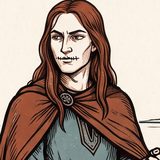 Loki
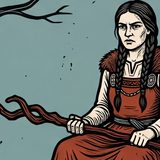 Angrboða
 Fenrir
 Jörmungandr
 Hel
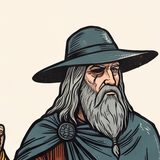 Óðinn
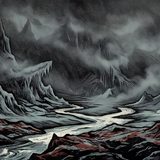 Niflheimr
 Týr
 Læðingr
 Drómi
 Skírnir
 Freyr
 Svartálfaheimr
 GleipnirLyngviÁmsvartnir
Why here in the order: No source dates it. Lokasenna, set after Baldr's death, already shows Týr one-handed (ls-p1), so it happened before that feast; placing it last among the gods' deeds is only a reading aid.