
Óðinn wins the runes
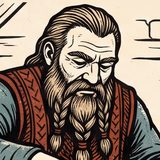
Wounded by a spear, Óðinn hung nine nights on a windswept tree as a gift to himself, then took up the runes, screaming.
Mímir: AI draft · not reviewed
- This story is told in one place only, near the end of Hávamál, and only in the speaker's own words. The poem closes by saying that these are the sayings of Hár, the High One, spoken in the High One's hall. The speaker shows who he is when he says he was given to Óðinn, 'myself to myself'. Hávamál 164, Hávamál 138
- He knows, he says, that he hung on a windy tree for nine whole nights, wounded with a spear and given 'To Othin, myself to myself', on the tree of which no one knows from what roots it rises. Hávamál 138
- No one gave him bread or a drink from a horn. He peered down and took up the runes; 'shrieking I took them', and then he fell back from there. Hávamál 139
- He learned nine mighty songs from the famous son of Bölþorn, Bestla's father, and got a drink of the precious mead, poured from Óðrerir. Snorri makes Bestla, Bölþorn's daughter, the mother of Óðinn, so this teacher would be his mother's brother; Hávamál does not say so. Hávamál 140, Gylfaginning 6
- Then he began to grow fruitful and wise, to grow and to thrive. 'Each word led me on to another word', and each deed to another deed. Hávamál 141
- He tells the listener: you will find runes and meaningful staves, very great and very strong, which the mighty sage coloured, the great gods made, and Hroftr of the gods carved. Óðinn carved them for the Æsir, Dáinn for the elves, Dvalinn for the dwarfs, Ásviðr for the giants, and some he carved himself. Hávamál 142, Hávamál 143
- Then come eight questions: do you know how to carve, how to read, how to colour, how to test, how to ask, how to sacrifice, how to send, how to slaughter? Better not to pray at all than to offer too much, for a gift always looks for a return. So Þundr carved, before the history of peoples, where he rose up when he came back. Þundr is one of the names Óðinn gives himself in Grímnismál. Hávamál 144, Hávamál 145, Grímnismál 54
- Last he lists eighteen charms he knows, which no king's wife or son of man knows. One helps against strife and sorrow; others blunt an enemy's blade, make fetters spring open, stop an arrow in flight, quench a burning hall, calm wind and sea, and turn a woman's heart. With the twelfth, when 'I see a hanged man swing', he can carve runes so that the man walks and talks to him. The eighteenth he will teach no one, except the woman in his arms or his sister. Hávamál 146, Hávamál 148, Hávamál 149, Hávamál 150, Hávamál 152, Hávamál 154, Hávamál 157, Hávamál 161, Hávamál 163
- Runes are remembered once more after the end of the world. In the renewed world of Völuspá the gods meet at Iðavöllr and call to mind 'the ancient runes' of Fimbultýr, the great god; the poem does not say these are the runes of Hávamál. Völuspá 60
Where the sources differ
Only Hávamál tells the hanging, and only in the first person; Snorri does not tell it. The poem does not name the tree; taking it for Yggdrasill is an interpretation, not something the text says. It also does not say why the speaker hung there, beyond what he gained. The English column in this part of Hávamál is offset from the Old Norse (hav-s138 also holds the end of the previous stanza), so the story follows the Old Norse rows.
Read it yourself
- Hávamál 138 — Nine nights on the windy tree, given 'myself to myself'.
- Hávamál 139 — No bread, no horn: he takes up the runes, screaming.
- Hávamál 143 — Who carved runes for whom: gods, elves, dwarfs and giants.
- Hávamál 157 — The twelfth charm: making a hanged man walk and talk.
Who takes part
Why here in the order: No source dates it. In the same passage the speaker says he got a drink of the mead poured from Óðrerir, so it is placed next to the mead of poetry; this is a reading aid.