
Þórr at Útgarða-Loki's
Þórr lost every contest in a giant's hall, and only learned on the way home that he had been fooled.
Mímir: AI draft · not reviewed
- Þórr drove out with his goats and Loki and stayed the night at a farmer's. He killed both goats for supper, invited the family to eat, and told them to throw the bones onto the hides. The farmer's son Þjálfi split a thigh bone to get at the marrow. Gylfaginning 44
- Before dawn Þórr raised Mjöllnir over the hides, and the goats stood up alive; but one was lame in a hind leg. The farmer and his household begged for mercy in terror. Þórr calmed down and took their children, Þjálfi and Röskva, as his servants; they have followed him ever since. Gylfaginning 44
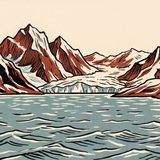
- Leaving the goats behind, Þórr went east towards Jötunheimar with Loki, Þjálfi and Röskva, across the deep sea and through a great forest. At night they sheltered in a huge empty hall with a door as wide as the hall. At midnight the ground shook, and they crept into a side room. Gylfaginning 45
- At dawn Þórr found a huge man asleep and snoring nearby. He put on his belt of strength, but for once he did not dare to strike. The giant said his name was Skrýmir and that he knew this was Ása-Þórr. He picked up his glove: it was the 'hall' they had slept in, and the side room was its thumb. Gylfaginning 45
- Skrýmir carried all their food in his bag. That night Þórr could not undo a single knot of it. In anger he struck the sleeping giant on the head with Mjöllnir three times. Each time Skrýmir woke and asked whether a leaf, an acorn or some twigs had fallen on him. In the morning he warned them not to boast at Útgarðr, and went off north. Gylfaginning 45
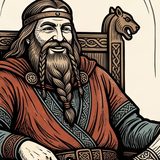
- They reached a stronghold so tall they had to bend their heads back to see the top, and squeezed in between the bars of the gate. Útgarða-Loki looked at them slowly and sneered: could this little lad be Öku-Þórr? Nobody stayed there, he said, without some skill beyond other men. Gylfaginning 46
- Loki offered to out-eat anyone. He and a man called Logi ate from either end of a trough of meat and met in the middle; Loki had eaten the meat, but Logi had eaten meat, bones and trough. Þjálfi raced a boy called Hugi three times, and lost each time by more. Gylfaginning 46
- Þórr tried to empty a drinking horn in three draughts and hardly lowered it. He tried to lift a grey cat and got only one paw off the floor. In anger he offered to wrestle, and was given Útgarða-Loki's old nurse, Elli. The harder he gripped, the firmer she stood, and at last he went down on one knee. Gylfaginning 46
- Next morning, outside the walls, Útgarða-Loki told the truth. He had been Skrýmir; the bag was tied with iron wire; the hammer blows had struck a hill, leaving three square valleys. Logi was wildfire, Hugi was his own thought, the horn's end lay in the sea, which is why the sea has ebbs. The cat was the Miðgarðr serpent, and Elli was old age, which brings everyone down. Gylfaginning 47
- He said Þórr would never be let in again. Þórr raised his hammer, but Útgarða-Loki was gone, and where the stronghold had stood there were only wide plains. Þórr went home to Þrúðvangar, resolved to meet the Miðgarðr serpent. Gylfaginning 47
Where the sources differ
Only Snorri tells the whole journey. The poems know it as a joke against Þórr: in Lokasenna and Hárbarðsljóð he is mocked for cowering in the thumb of a glove (ls-s60, hrbl-s26), and Loki reminds him he could not open Skrýmir's food bag (ls-s62). In Hárbarðsljóð the giant who might hear him there is called Fjalarr, not Skrýmir. Hymiskviða blames Loki for the lame goat (hym-s37); Snorri blames Þjálfi.
Read it yourself
- Gylfaginning 45 — The 'hall' turns out to be a giant's glove.
- Gylfaginning 46 — Þórr wrestles an old woman, and falls to one knee.
- Gylfaginning 47 — The giant explains every trick.
Who takes part
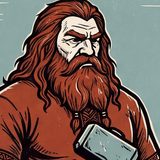 Þórr
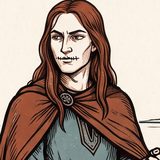 Loki
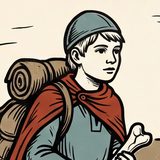 Þjálfi
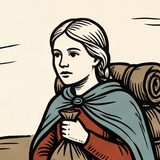 Röskva
 Mjöllnir
 Jötunheimar
 Skrýmir
 Útgarða-Loki
 Útgarðar
 Logi
 Hugi
 Elli
 Jörmungandr
 Þrúðvangar
Why here in the order: No source dates it; Snorri says Þórr's fishing trip followed soon after, so it is placed just before that story.