
Þórr fishes for the serpent
Þórr used an ox's head as bait and hooked the serpent that circles the world.
Mímir: AI draft · not reviewed
- Soon after the Útgarða-Loki journey, Þórr set out to make up for it. He took no chariot, no goats and no companions, crossed Miðgarðr looking like a young boy, and spent the night with the giant Hymir. Gylfaginning 48
- At dawn Hymir got ready to row out fishing. He said a small boy would be no use and would freeze. Þórr, angry enough to hammer him, held back because he meant to test his strength elsewhere. Hymir told him to find his own bait. Gylfaginning 48
- Þórr tore the head off Hymir's biggest ox, Himinhrjóðr. He rowed so hard that they passed Hymir's usual fishing grounds, then the point where Hymir said it was dangerous because of the Miðgarðr serpent, and kept going. Gylfaginning 48
- He baited a huge hook with the ox head. The serpent took it, and jerked so hard that both Þórr's fists struck the gunwale. In his god-strength Þórr braced so hard that his feet went through the boat to the sea floor, and he hauled the serpent up to the side. Þórr glared down; the serpent glared up and blew poison. Gylfaginning 48
- Hymir went pale with fear as the sea poured in and out of the boat. Just as Þórr raised his hammer, Hymir cut the line and the serpent sank. Some say Þórr's hammer struck off its head among the waves, but Hárr believes it still lives in the ocean. Þórr knocked Hymir overboard and waded ashore. Gylfaginning 48
- Hymiskviða tells a different story around the fishing. The gods, feasting, needed a kettle big enough for Ægir to brew ale for them all. Týr told Þórr that his own father, Hymir, who lives east of Élivágar at the edge of heaven, owns a kettle a league deep. Hymiskviða 1, Hymiskviða 3, Hymiskviða 4, Hymiskviða 5
- They left Þórr's goats with Egill and went to Hymir's hall. Týr's nine-hundred-headed grandmother loathed him, but his mother hid them. Hymir came in from hunting with frozen beard; his glance split a pillar. Three oxen were cooked, and Þórr ate two by himself. Hymiskviða 7, Hymiskviða 8, Hymiskviða 10, Hymiskviða 12, Hymiskviða 15
- Next day they went fishing. Þórr tore the head off a black ox for bait. Hymir pulled up two whales at once. Þórr hooked the serpent, dragged it to the boat and struck its head with his hammer; rocks roared and the old earth shook, and then 'the fish' sank into the sea. Hymiskviða 18, Hymiskviða 19, Hymiskviða 21, Hymiskviða 22, Hymiskviða 23, Hymiskviða 24
- Hymir still doubted his strength: no one was strong who could not break his cup. Þórr threw it through stone pillars and it stayed whole, until Hymir's woman told him to strike it on Hymir's own skull, which was harder. The cup shattered. Hymiskviða 28, Hymiskviða 29, Hymiskviða 30, Hymiskviða 31
- Týr could not even move the kettle. Þórr put it on his head, his feet breaking through the floor and its rings clattering at his heels, killed the many-headed giants who chased them, and brought it to the gods' assembly. Now the gods can drink ale in Ægir's hall. Hymiskviða 33, Hymiskviða 34, Hymiskviða 35, Hymiskviða 36, Hymiskviða 39
Where the sources differ
In Hymiskviða the fishing is one episode in a quest for Hymir's great kettle, and Týr calls Hymir his father (hym-s5); Snorri calls Týr Óðinn's son (s-c16-1) and tells only the fishing. In the poem Þórr strikes the serpent with his hammer and it sinks; Hymir does not cut the line. Snorri reports that some say the hammer took off its head, but he thinks it still lives. Hymiskviða blames Loki for the lamed goat on the way home (hym-s37); Snorri blames Þjálfi in an earlier story (g-c44-7).
Read it yourself
- Gylfaginning 48 — Feet through the boat, and the serpent's poison breath.
- Hymiskviða 23 — The poem's version: Þórr strikes the serpent's head.
- Hymiskviða 34 — Þórr walks off wearing the giant's kettle.
Who takes part
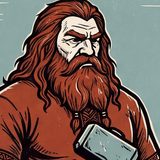 Þórr
 Hymir
 JörmungandrHiminhrjóðr
 Miðgarðr
 Týr
 Ægir
 Élivágar
 Egill
 Mjöllnir
Why here in the order: Snorri says Þórr set off on this trip soon after coming home from Útgarða-Loki, to make up for that journey.