
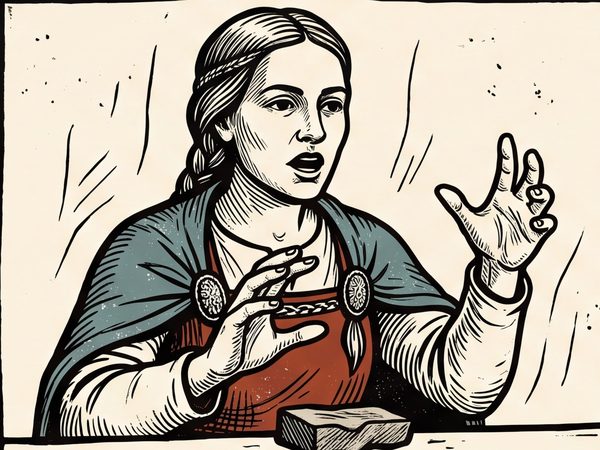
Gróa
GROH-a [ˈkrouːa] ? pronunciation: draft
Gróa
person
A wise woman whose spells nearly freed the whetstone from Þórr's head, until joy made her forget them.
Mímir: AI draft · not reviewed
Key facts
- Who
- A seeress (völva), wife of Aurvandill the Bold Skáldskaparmál 25Aurvandill
- Known for
- After the fight with Hrungnir, she sang spells over Þórr at Þrúðvangr until the whetstone in his head began to loosen. Þórr told her he had carried Aurvandill out of Jötunheimar in a basket and made his frozen toe a star. She was so glad that she forgot her spells, and the stone is still in his head Skáldskaparmál 24, Skáldskaparmál 25
 Þórr
 Þrúðvangar
 Hrungnir
- Appears in
- Grógaldr has a dead Gróa, woken at her grave by her only son, who asks for her help; she sings him charms, the first one Rani sang to Rindr. The Old Norse calls him only Sonr (son); the English names him Svipdagr. Whether this is the same Gróa is not said Grógaldr 1, Grógaldr 2, Grógaldr 6
 Rindr
Read it yourself
- Skáldskaparmál 25 — Snorri's tale of the whetstone, the basket and Aurvandill's toe.
- Grógaldr 1 — Her son wakes her at the doors of the dead.
- Grógaldr 6 — The first of her charms.
In the stories
The story in brief
Gróa is a wise woman (völva) who appears in two unrelated contexts. In Skáldskaparmál chapter 25 she is the wife of Aurvandill the Bold; after Þórr's duel with Hrungnir she sings spells over him to loosen the piece of whetstone lodged in his head. When Þórr, to reward her, tells how he carried Aurvandill out of giant-land in a basket and made a star of his frozen toe, she forgets her spells for joy, so that the stone stays in his head.
In Grógaldr ("Gróa's spell"), the dead Gróa is the mother of Svipdagr, who wakes her at her grave to ask for help on a dangerous quest; she sings him a series of protective charms, the first of which "Rani taught to Rind" (stanza 6). Whether the two Gróas were thought of as the same figure is uncertain.
Summary: AI draft · not reviewed