
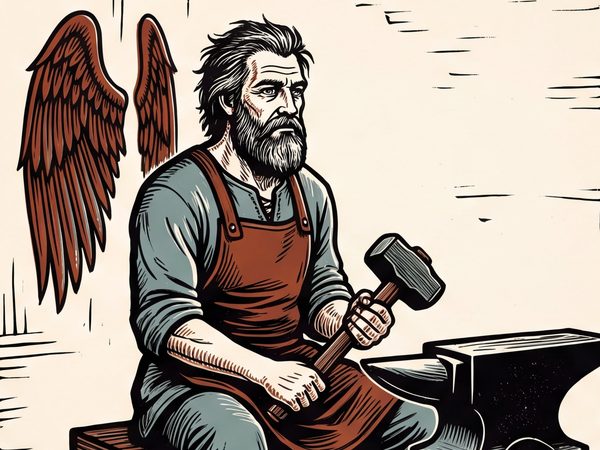
Völundr
VUR-lun-dur [ˈvœːlʏntʏr̥] modern Icelandic: Völundur ? pronunciation: draft
Wayland the Smith
hero
A master smith, lamed and imprisoned by a king, who took a terrible revenge and rose into the air laughing.
Mímir: AI draft · not reviewed
Key facts
- Who
- Völundr, son of a king of the Finns, brother of Slagfiðr and Egill; "a most skillful man, as men know from old tales". The poem calls him "greatest of elves" and "master of elves". Völundarkviða 1, Völundarkviða 13, Völundarkviða 10
 Slagfiðr
 Egill
- Wife
- Hervör the all-wise, a valkyrie in swan's garb, daughter of King Hlöðvér. After seven winters she flew away and did not come back. Völundarkviða 1, Völundarkviða 3
 Hervör alvitr
 Hlöðvér
- Lost
- His freedom: King Níðuðr took him asleep, kept his sword and gave one of his rings to Böðvildr. On the queen's advice his knee sinews were cut and he was set to forge on an island. Völundarkviða 11, Völundarkviða 2, Völundarkviða 17, Völundarkviða 3
 Níðuðr
 Böðvildr
- Known for
- His revenge: he killed the king's two sons, set their skulls in silver for the king, made gems of their eyes for the queen and a brooch of their teeth for Böðvildr, and left Böðvildr pregnant Völundarkviða 24, Völundarkviða 25, Völundarkviða 36NíðuðrBöðvildr
- Fate
- "Laughing Völund rose aloft", out of anyone's reach; the poem does not say how he flew Völundarkviða 29, Völundarkviða 38, Völundarkviða 37Níðuðr
Read it yourself
- Völundarkviða 1 — The swan-maidens arrive and leave: how the story starts.
- Völundarkviða 24 — The revenge begins in the smithy.
- Völundarkviða 38 — Völundr escapes into the air; Níðuðr is left behind.
In the stories
The story in brief
Völundr is the master smith of Germanic legend, known in English as Wayland. In the prose and stanzas of Völundarkviða he is one of three brothers, with Slagfiðr and Egill, sons of a king of the Finns; the three live for some years with swan-maidens who then fly away (2-5). Alone in Úlfdalir, Völundr is captured by King Níðuðr of the Njárar (6-13), who takes his ring and sword; on the queen's advice he is hamstrung and set to work on an island.
He takes revenge by killing Níðuðr's two sons, making goblets of their skulls, gems of their eyes and a brooch of their teeth for their sister Böðvildr (25), and by seducing Böðvildr when she brings him a broken ring to mend (26-27). He then rises into the air and, once Níðuðr has sworn not to harm his wife and child, tells the king what he has done (29-38). The poem calls him a prince of the elves (32). The story is also known in the Old English poem Deor, on the Franks Casket and in Þiðreks saga.
Summary: AI draft · not reviewed