
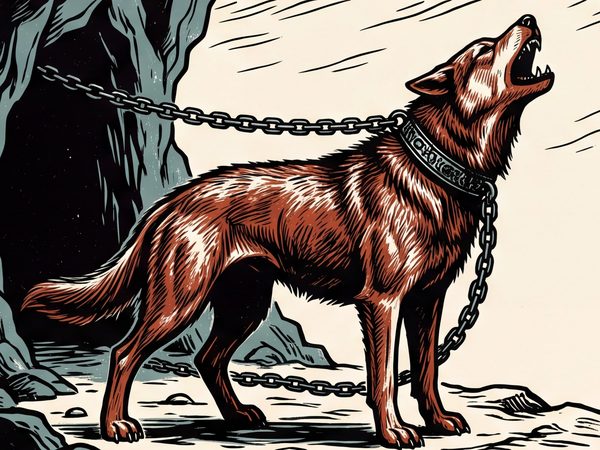
Garmr
GAR-mur [ˈkarmʏr̥] modern Icelandic: Garmur ? pronunciation: draft
Garmr · Garmur
monster · animal
The best of hounds, bound before the cave Gnipahellir; his howling marks the coming of Ragnarök.
Mímir: AI draft · not reviewed
Key facts
- Who
- A hound: “of hounds Garmr” is the best, as Sleipnir is of horses Grímnismál 44, Gylfaginning 41
 Sleipnir
- Home
- Bound before Gnipahellir; Snorri calls him “the greatest monster” Gylfaginning 51
 Gnipahellir
- Known for
- Völuspá's refrain: “Now Garm howls loud before Gnipahellir”; the fetter will break and the wolf run free Völuspá 44, Völuspá 49, Völuspá 58
- Fate
- Loose at Ragnarök, he fights Týr, and each kills the other Gylfaginning 51
 Týr
- Known for
- In Baldrs draumar Óðinn meets a hound coming from Hel, bloody on the breast; the poem does not name it Baldrs draumar 2, Baldrs draumar 3
 Óðinn
Read it yourself
- Völuspá 44 — The seeress's refrain, repeated as the end draws near.
- Gylfaginning 51 — Garmr and Týr kill each other in the last battle.
- Grímnismál 44 — The list of the best: tree, ship, god, horse, hound.
In the stories
The story in brief
Garmr is a monstrous hound bound at Gnipahellir, whose breaking loose signals the beginning of Ragnarök.
In Völuspá the refrain "Garmr howls loud before Gnipahellir, the fetters will burst and the wolf run free" recurs as the end of the world approaches (stanzas 44, 49 and 58 in Bellows' numbering). Grímnismál 44, quoted in Gylfaginning chapter 41, calls him the best of hounds, as Yggdrasill is best of trees and Sleipnir of horses. In Gylfaginning chapter 51 Snorri describes him as loosed from his bonds before Gnipahellir and as the worst of monsters; in the last battle he fights the god Týr, and each kills the other. Some scholars identify him with the wolf Fenrir, whom the Völuspá refrain may also refer to.
Summary: AI draft · not reviewed