
The sleeping valkyrie
Sigurðr cut the mail off a sleeping warrior and found a woman Óðinn had punished. Awake, she taught him runes and counsel.
Mímir: AI draft · not reviewed
- After Sigurðr killed Fáfnir, birds told him of a hall high on Hindarfjall, ringed with fire. A battle-maiden slept there: Yggr, that is Óðinn, had pricked her with a thorn because she struck down a different man from the one he wanted. Fáfnismál 42, Fáfnismál 43, Fáfnismál 44, Grímnismál 54
- Sigurðr rode up Hindarfjall, heading south towards the land of the Franks. He saw a great light, as if a fire burned up to the sky, and found a wall of shields with a banner above it. Inside lay someone asleep in full armour. He took off the helmet and saw it was a woman. The mail-coat was as tight as if it had grown into her flesh, so he cut it open with his sword Gramr, down from the neck and out along both sleeves, and she woke. Sigrdrífumál 1
- She asked what had cut through her mail and who had freed her. Sigmundr's son, he said, with Sigurðr's sword. She said she had slept long: Óðinn had made it so, and she could not throw off the sleep-spells. Sigrdrífumál 1, Sigrdrífumál 2
- She gave him a horn of mead as a memory-drink and greeted the day, the night, the gods, the goddesses and the earth, asking them for wisdom, speech and healing hands for the two of them. Sigrdrífumál 2, Sigrdrífumál 3, Sigrdrífumál 4
- She was called Sigrdrífa, and was a valkyrie. Two kings had fought: old Hjálmgunnarr, to whom Óðinn had promised victory, and Agnarr, brother of Auða, whom no one would help. She struck down Hjálmgunnarr. In return Óðinn pricked her with a sleep-thorn, said she would never again win a battle, and that she must marry. She vowed in turn never to marry a man who knew fear. Sigrdrífumál 3, Sigrdrífumál 1, Sigrdrífumál 4
- Sigurðr asked her to teach him wisdom. She brought him beer full of spells and taught him runes: victory runes to carve on the sword hilt, calling twice on Týr; ale-runes, so another man's wife could not betray him; runes to help a woman give birth; runes to keep ships safe; runes for healing; speech-runes for the assembly, so that no one repays a wrong with hatred; and runes for a wise mind. Sigrdrífumál 4, Sigrdrífumál 5, Sigrdrífumál 6, Sigrdrífumál 7, Sigrdrífumál 9, Sigrdrífumál 10, Sigrdrífumál 11, Sigrdrífumál 12, Sigrdrífumál 13
- She told where the runes came from. Hroptr, a name of Óðinn, devised them from the liquid that had dripped from Heiðdraupnir's skull and Hoddrofnir's horn, and Mímir's head spoke the first wise words. The runes were carved on many things, then shaved off, mixed into the holy mead and sent far and wide: some to the Æsir, some to the elves, some to the Vanir, and some to men. Sigrdrífumál 13, Sigrdrífumál 14, Sigrdrífumál 18, Grímnismál 8
- Then she offered him a choice, speech or silence: all harm is already measured out. Sigurðr answered: 'I shall not flee, though my fate be near.' He wanted all her counsel for as long as he lived. Sigrdrífumál 20, Sigrdrífumál 21
- She gave him eleven counsels. Be blameless towards your kin and slow to take revenge. Swear no oath that is not true. Do not argue with fools at the assembly. Do not stay the night with a witch. Do not let lovely women rob you of sleep. Do not quarrel with drunk men. Fight rather than be burned in your hall. Seduce neither girl nor wife. Wash, comb and bury any dead you find. Never trust the son of a man you have killed, however much gold he takes. And beware of treachery from friends: she does not foresee a long life for the prince. Sigrdrífumál 22, Sigrdrífumál 23, Sigrdrífumál 24, Sigrdrífumál 26, Sigrdrífumál 28, Sigrdrífumál 29, Sigrdrífumál 31, Sigrdrífumál 32, Sigrdrífumál 33, Sigrdrífumál 34, Sigrdrífumál 35, Sigrdrífumál 37
- Snorri tells the waking in a few lines: the woman Sigurðr freed named herself Hildr; she is called Brynhildr, and was a valkyrie. In Helreið Brynhildar, Brynhildr herself tells the same story as Sigrdrífa: people called her Hildr-under-helmet, she sent old Hjálmgunnarr to Hel and gave victory to Auða's brother, and the angry Óðinn shut her in with shields and decreed that only a man who knew no fear should break her sleep. Skáldskaparmál 48, Helreið Brynhildar 6, Helreið Brynhildar 7, Helreið Brynhildar 9, Helreið Brynhildar 10
Where the sources differ
Sigrdrífumál calls her Sigrdrífa (sd-p3, fm-s44). Snorri says she named herself Hildr and is called Brynhildr (s-c48-1), and in Helreið Brynhildar it is Brynhildr who tells of Hjálmgunnarr, Auða's brother and Óðinn's punishment (hlr-s9, hlr-s10). Helreið adds that a young king had carried off the shapes of her and seven sisters, so she swore oaths to him (hlr-s8), and that Óðinn ringed her hall with fire which only the man who brought Fáfnir's gold should cross (hlr-s11). In Sigrdrífumál she lies inside a shield-wall glowing like fire (sd-p1). In Snorri she later waits behind flickering fire to be won for Gunnarr (s-c48-3). Sigrdrífumál ends with the eleventh counsel (sd-s37) and does not tell what Sigurðr did next. The English column of this poem is often a stanza off, and its heading 'Brynhild spake' at sd-s20 is not in the Old Norse.
Read it yourself
- Sigrdrífumál 1 — A wall of shields, a helmet lifted, a woman underneath.
- Sigrdrífumál 3 — Her greeting to day and night on waking.
- Sigrdrífumál 21 — Sigurðr will not flee, though his fate is near.
Who takes part
 Sigurðr Fáfnisbani
 Sigrdrífa
 Brynhildr Buðladóttir
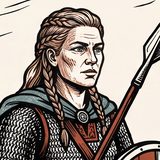 Hildr
 Hindarfjall
 Gramr
 Óðinn
 Hjálmgunnarr
 Týr
 Mímir
Why here in the order: Fáfnismál ends with birds telling Sigurðr of the sleeping maiden on Hindarfjall, and Sigrdrífumál takes up the story there. Snorri tells the waking just before Sigurðr comes to King Gjúki.